
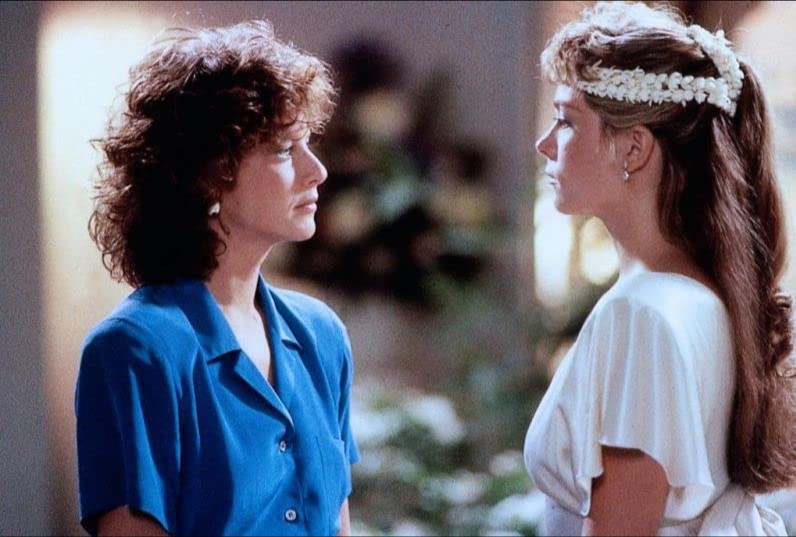
February 6, 1987 | The lines between hunter and hunted get blurred once again in Black Widow, an ingeniously plotted and stylishly directed psychological thriller that brings out the very best in Debra Winger and Theresa Russell, its two attractive stars.
Russell gets the glamour role, playing a chameleon-like beauty known as Catharine. A cool femme fatale who marries, then murders, wealthy men, Catharine has developed — presumably, after years of practice — a simple but effective method of operation. First, she targets an older man of means, learns his hobbies and interests, and transforms herself into the woman of his dreams. Then she enters the poor fellow’s life, and convinces him that he’s finally found Miss Right. (One potential victim notes, with unintentional irony: “You seem almost too good to be true.”)
Finally, before the romance fades and dull routine sets in, she slips a difficult-to-trace poison into his drink, then arranges to be out of town when he has his final nightcap. She returns home, briefly mourns, then slips off into oblivion with another sizable inheritance.
It’s a clever routine, one that might have gone unnoticed except for the efforts of Alex Barnes, a drab Justice Department data analyst played by Debra Winger. While checking into an unrelated case, Alex notes an unusual coincidence: Two different men, each married to a younger, very attractive woman, have died in recent months of the same bizarre malady. Both men were very rich. Their widows bear a striking resemblance.
Alex senses something fishy, and jumps at the chance for the excitement of a field investigation. Her boss is glad to see her show some interest in a life away from her video display terminal. But he doesn’t think a mere woman would be capable of “a complex series of seductions and murders.” Alex bristles. And, more important, she digs. But when another wealthy husband turns up dead, shortly after Alex questions him about his new wife, Alex’s obsessions are fed by guilt as well as professional zeal.
So far, so good. But then Black Widow gets even better, as Alex, who has too long channeled her passions in workaholism, tracks Catharine to Hawaii, where the mystery lady has already picked out a new victim. Much to Alex’s surprise, they strike up a friendship, discovering they share a similar strong-willed intelligence. Catharine lends Alex expensive clothes, gives her grooming and make-up tips. Alex blossoms — to the point where she catches the eye of Catharine’s fiance, Paul (Sami Frey), an international hotel magnate.
Black Widow dawdles a bit in the final third, as the tangled motives and relationships are dramatized. But even then, director Bob Rafelson (Five Easy Pieces) infuses the film with slow-simmering suspense and a palpable sexual tension. There is a provocative ambiguity to many developments, made all the more tantalizing by Rafelson’s habit of cutting scenes short with abrupt fade-outs. Rafelson is very clever — he leads us to accept this transitional device as perfectly natural, so he can pull off a major twist without having to explain why certain information is withheld.
Rafelson and scriptwriter Ronald Bass allow their vividly drawn characters to be as complex as the plot. When Alex falls for Paul, we cannot help wondering if she’s as manipulative as Catharine — and if sexual jealousy has been part of Alex’s motivation all along. And what about Catharine’s motivation? Well, Black Widow doesn’t cop out with clinical mumbo-jumbo or melodramatic flashbacks: Catharine does what she does because she does it. In fact, Alex warns us early on about the pitfalls of seeking easy solutions to mysteries of human behavior.
The movie has been given a lush, neo-film noir look by cinematographer Conrad L. Hall and production designer Gene Callahan, often recalling glossy Hollywood productions of the ’40s. The plot has vague echoes of more recent thrillers, particularly Body Heat and Manhunter, but not so many as to be distracting.
Much like the current Outrageous Fortune, which has Bette Midler and Shelley Long in buddy-buddy roles usually reserved for men, Black Widow gains an intriguing texture by having women as deadly protagonists. The men who figure prominently in the story — Dennis Hopper and Nicol Williamson as luckless husbands, Sami Frey as a victim-to-be, James Hong as a seedy private eye — are well cast. And there is some nice work done by supporting actresses in cameo bits: Mary Woronov as a scuba diving instructor, Diane Ladd as a victim’s greedy sister, Lois Smith (Jack Nicholson’s sister in Five Easy Pieces) as another victim’s loyal secretary. But the movie is first and last a showcase for its stars.
Russell gives a performance of great variety and scope, suggesting there is genuine love behind Catharine’s murderous impulses. Her icy facade slips a bit whenever an unexpected event upends her carefully laid plans, enabling Russell to give us a glimpse at the insecure little girl who may be seeking revenge on father figures. Much to the film’s credit, however, neither Russell nor the script hammer at this too insistently.
Winger is equally impressive as Alex, coming off as abrasively tenacious yet ingratiatingly vulnerable. She laces her steel-spined resolve with a poignant hint of loneliness. And she has a good eye for detail: The way she shakes the kinks from her neck after a long day at the computer will strike a sympathetic chord in any viewer who spends much time in front of a monitor.
Russell and Winger share a terrific moment late in the film, when Catharine, suddenly recognizing so much of herself in Alex, impulsively kisses Alex on the mouth. Some critics will point to this gesture as a sign of lesbian impulses, but I think there’s much more to it than that. The way Winger and Russell play the scene, I suspect what we’re really seeing is a mutual acknowledgement that the game is over, that only one player will prevail. It’s an inspired touch, one of many that make Black Widow an uncommonly absorbing entertainment.
